
Creative Infidelity
Workshop by Pêdra Costa
Zeitgenössische Kunst
Theorie
Workshop
Verbindung zu esel.at
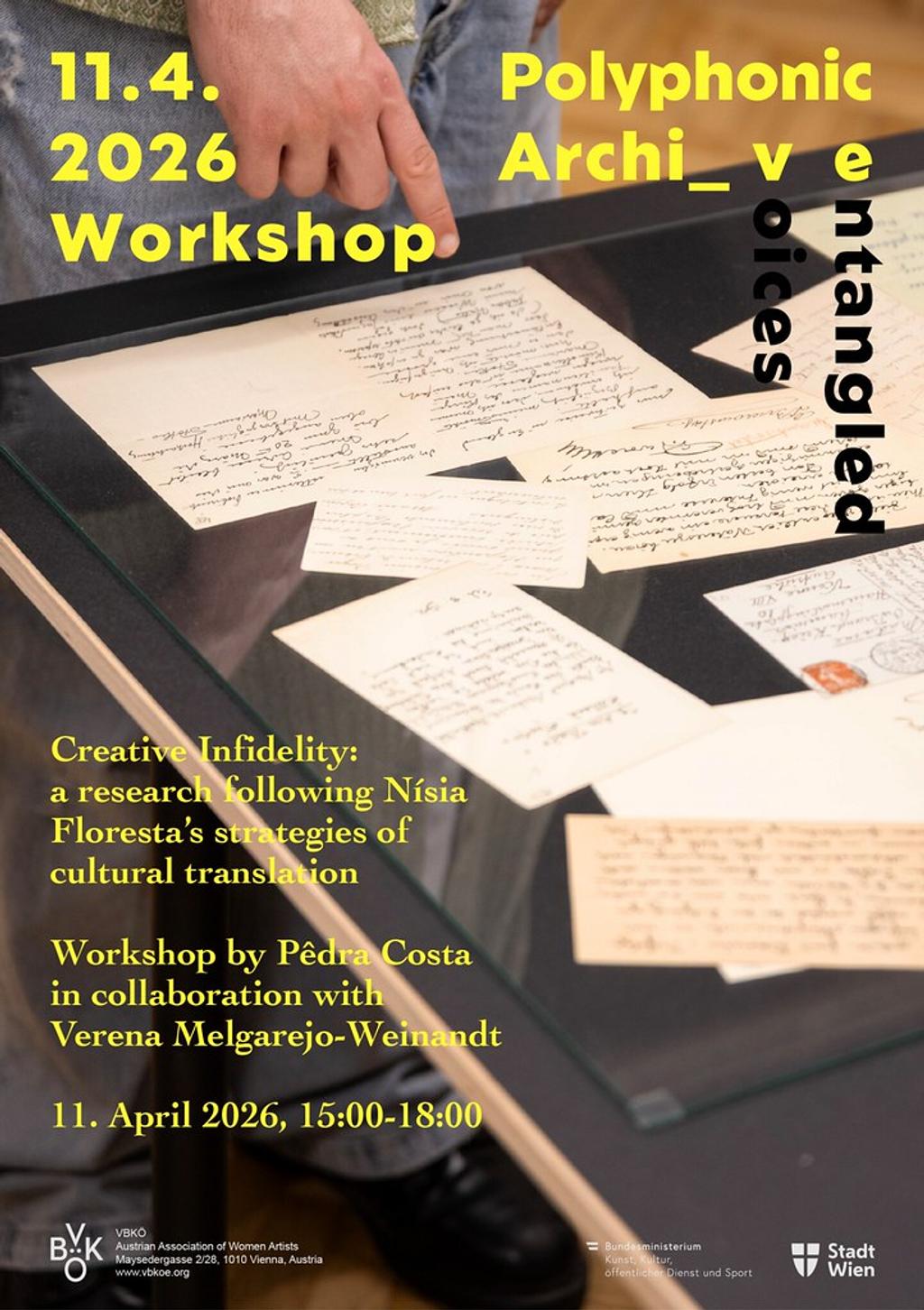
Creative Infidelity: a research following Nísia Floresta’s strategies of cultural translation
Workshop by Pêdra Costa
***
Saturday, April 11, 2026, 15:00-18:00
Guest: Verena Melgarejo-Weinandt
Creative Infidelity: a research following Nísia Floresta’s strategies of cultural translation is a project that approaches the archive as a living organism. Inspired by the Brazilian feminist thinker, educator, and translator Nísia Floresta (1810–1885), the project proposes “infidelity” as a methodology: instead of literal translation, it engages in creative transformation and cultural rewriting of archival materials. Floresta’s writings defending women’s education, social justice, and racial equality in 19th-century Brazil connected feminist ideas across Brazil, Europe, and North America while affirming the value of local and ancestral knowledge. Drawing on this legacy, the workshop activates the VBKÖ archive through practices of cultural translation, affective reading, and performative rewriting, linking historical documents with contemporary political struggles and collective memory.
The program includes two public workshops: one with Verena Melgarejo-Weinandt, exploring affective approaches to archival research inspired by encounters with the archive of Gloria E. Anzaldúa, and another with Sushila Mesquita, focused on collective queer-feminist text recomposition.
*Pêdra Costa is a performer, tarot reader, and visual and urban anthropologist. As an anti-disciplinary artist, they bring together body practices, visual arts, video, writing, and electronic music. Their practice merges academic research, body arts, and spiritual technologies. Engaging embodied and invisible knowledge, Pêdra draws on queer and ancestral wisdom, decoding violence and transforming failure whilst mobilizing the potencies of art and life as integral to anti-colonial and necropolitical survival.
*Verena Melgarejo-Weinandt is an artist, curator, educator, and researcher. Her practice bridges artistic, spiritual, and pedagogical fields through methods she calls arte-sana. She has curated projects related to Gloria E. Anzaldúa’s legacy, and her work has been exhibited across Europe and Latin America, including the Museo de Arte Contemporáneo Salta, nGbK Berlin, and the Wiener Festwochen.
