
Seth Weiner: The Palais des Beaux Arts Wien
Zeitgenössische Kunst Theorie Vortrag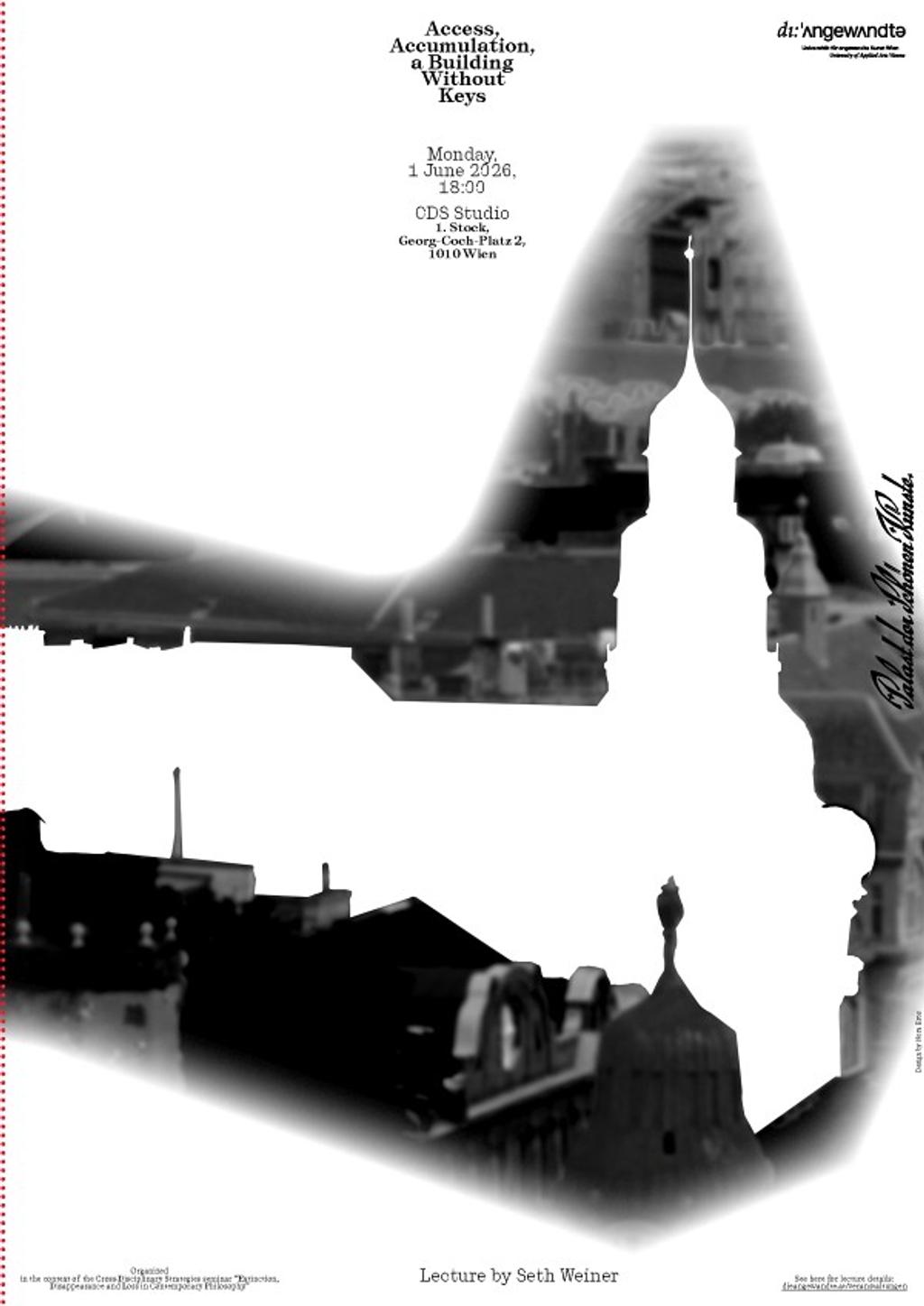
Verbindung zu esel.at
Access, Accumulation, a Building Without Keys
Lecture by Seth Weiner
In progress and without keys to the building it occupies, the Palais des Beaux Arts Wien is a museum-like entity that functions as a mobile place of remembrance and projection for what was lost during National Socialism. The exhibitions of the Palais take place across multiple times and places: on its website, in archives, on sidewalks, through tours, and elsewhere.
Built in 1908 as the home of Atelier Bachwitz, an international publisher of fashion and lifestyle magazines, the Palais was Aryanized in 1938. Thereafter, the family was displaced, members were lost to the Holocaust, and the institution’s activities were cut short.
And yet the Palais today continues to accumulate. After decades of neglect, Bernhard Garnicnig encountered the building in 2014 and transformed it into a post-digital institutional surface. Afterwards, Seth Weiner extended the Palais’s historically interrupted activities by reattaching lost narratives, and Anna Weberberger is now initiating a new turn towards the Palais’s passing futures. The aim of the project, and the subject of this talk, is to find ways of continuing without erasing what came before.
Seth Weiner is an artist, teacher, and Collection Custodian for the Palais des Beaux Arts Wien, where he served as Artistic Director from 2019 to 2025. Seth studied architecture at Southern California Institute of Architecture (Los Angeles), drawing and painting at the University of Michigan (Ann Arbor), and sound at the Center for the Creation of Music Iannis Xenakis (Paris). Seth’s work explores the distance between architectural fiction and social convention in order to create spatial environments that are at once real and imagined. His work has been exhibited at the MAK Museum Vienna, Pacific Standard Time Performance Festival Los Angeles, Wien Museum - MUSA, Festival der Regionen Upper Austria (FdR), Russell Center - Detroit, Kunstraum Niederösterreich Vienna, among others.
palaisdesbeauxarts.at
sethweiner.org
Organized by Ryan Crawford in the context of his Cross-Disciplinary Strategies seminar Extinction, Disappearance and Loss in Contemporary Philosophy