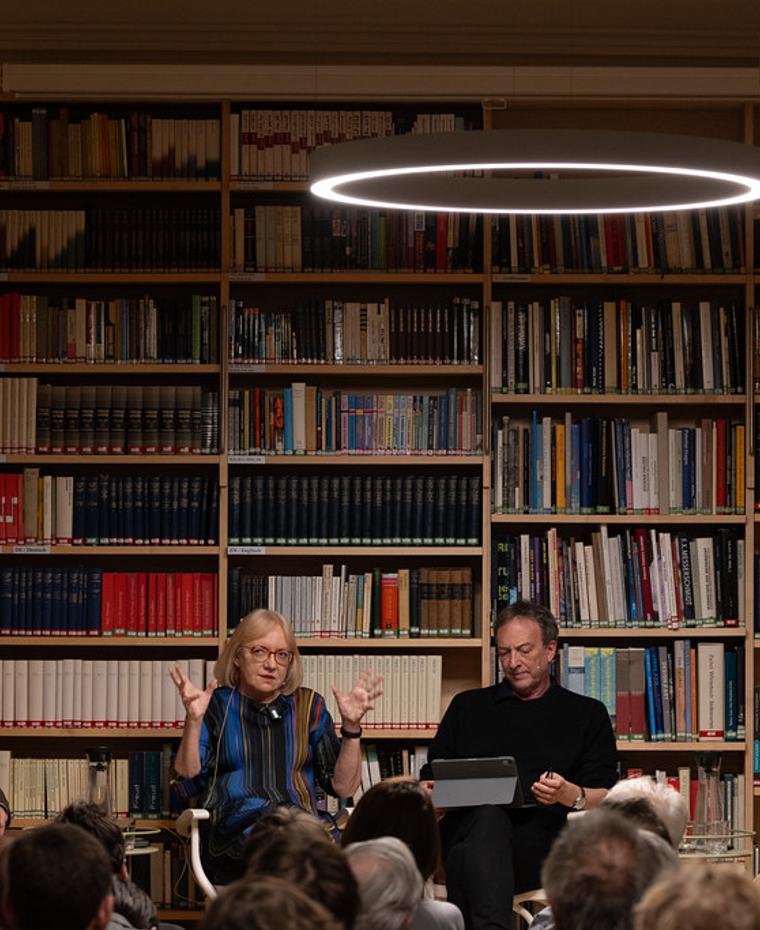
Resistance in Crumbling Democracies
Theorie Zivilgesellschaft Diskussion
Verbindung zu esel.at
Podiumsdiskussion in Englisch
Eine Kooperation des Sigmund Freud Museums mit dem Institut für die Wissenschaften vom Menschen (IWM), unterstützte von der Freud Foundation US
Am Podium:
Renata Salecl, Professor of Psychoanalysis/Psychology, Birkbeck University of London
Michael S. Roth, Historian, President of Wesleyan University, US
Slobodan Markovich, Historian, Political Anthropologist, University of Belgrade
IWM-Rektor Misha Glenny kommentiert und moderiert die anschließende Q&A session.
Resistance is not only a common term in current political discourse; in psychoanalysis, it refers to an avoidance tactic directed against the conscious recognition of repressed content, whereas in society, it is a conscious act directed against the actions of an authority perceived as wrong or immoral.
In psychoanalytic therapy, a patient’s unconscious resistance is a crucial indicator for the analyst seeking a path to healing. Similarly, societal resistance is central to a healthy democracy. For several years now, democracies and civic participation have been under threat in various parts of the world. Institutions of the rule of law and civil society have been weakened, and authoritarianism has been on the rise.
We have invited three renowned scholars to give their view, from a practical and a scholarly perspective, on what happens to society when politics slides into authoritarianism. Will the threats posed by authoritarian regimes transform the will to resist into a passive acceptance of a new reality, akin to the resistance against change identified in psychoanalysis? What dangers does that engender for civil society? And is this something that institutions should be preparing for?
In accordance with the Sigmund Freud Museum’s annual theme “Resistance,” this discussion aims to delve deeper into the dynamics and motives within societies, both conscious and unconscious, as the prospect of authoritarianism and even fascism appears greater than it has done since the end of World War II.
Michael S. Roth has been president of Wesleyan University (Middletown, Connecticut) since 2007. As a historian, Roth is known for his work as an administrator, scholar, and public intellectual. He regularly publishes essays, book reviews, and commentaries in the US media and scholarly journals. An outspoken defender of the value of colleges and universities and their importance to democracy, he was given the PEN/Benenson Courage Award in 2025 for standing up against governmental assaults on higher education. Among his publications are: Psycho-Analysis as History: Negation and Freedom in Freud (Cornell University Press, 1987, 1995), Memory, Trauma, and History: Essays on Living with the Past (Columbia University Press, 2012), Safe Enough Spaces: A Pragmatist’s Approach to Inclusion, Free Speech, and Political Correctness on College Campuses (2019), The Student: A Short History (2023). He is board member of the Freud Foundation US.
Renata Salecl is a professor of psychology/psychoanalysis and law at Birkbeck Law School in London and a senior researcher at the Institute of Criminology at the Faculty of Law in Ljubljana, Slovenia. She has held numerous visiting professorships at the Cardozo School of Law in New York, the Humboldt University of Berlin, and Duke University in Durham, among other institutions. Her interdisciplinary work focuses on bringing together law, criminology, the study of political ideologies, and psychoanalysis. Salecl is the author of The Spoils of Freedom: Psychoanalysis and Feminism after the Fall of Socialism (Routledge, 1994), (Per)versions of Love and Hate (Verso, 1998), On Anxiety (Routledge, 2004), Tyranny of Choice (Profile Books, 2010), and A Passion for Ignorance (Princeton University Press, 2020). She was awarded the title of Slovenian Woman Scientist of the Year by the Slovenian Ministry of Science in 2010.
Slobodan G. Markovich, MBE, is Full Professor of Political and Cultural Anthropology and Political History of SEE at the Faculty of Political Science, University of Belgrade. His books, edited volumes, and studies deal with British-Balkan relations, democracy in South-East Europe, and European cultural transfer. He has also published works on Sigmund Freud and psychoanalytic anthropology and takes an interest in the history of European pessimism. He has been the head of the Centre for British Studies/FPS since its inception in 2017, and an Associate at LSE IDEAS since 2019. Since 2016, he has been co-organiser of biennial conferences “PSY and Culture” in Belgrade. In 2023, he was a Krzysztof Michalski Fellow at the Institute for Humanistic Sciences (IWM) in Vienna. He is a member of Academia Europaea (the Academy of Europe).
This registration is for the event on site. We kindly ask for binding registration. After submitting your data, you will receive a confirmation via e-mail.