
Politics Of Appearance
Zeitgenössische Kunst Ausstellung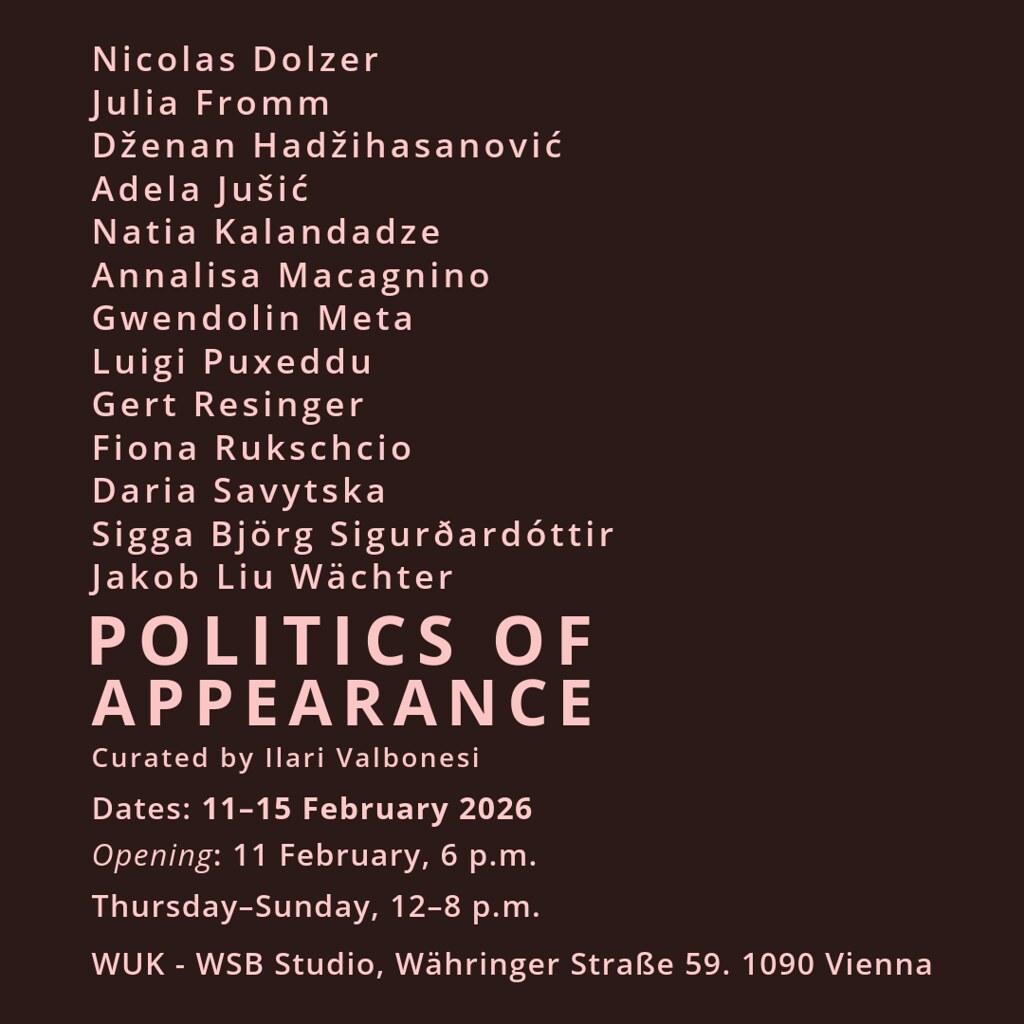
Verbindung zu esel.at
In the world from which we come and to which we return, Being and Appearing coincide (Arendt, 1978).
Drawing on Hannah Arendt’s concept of appearance, POLITICS OF APPEARANCE, curated by Ilari Valbonesi, brings together international artists whose practices explore appearance not as mere surface, but as a political event—understood as inherently plural.
This (political) appearance is neither a character of the artwork nor an impression of the viewer; it emerges in the relationship between artworks and viewers. It resembles a kind of birth, triggering unpredictable effects through movement, affection, corporeality, matter, sound, light, memories, disguises and desires.
Artworks enter the scene as new beginnings, prompting movement, positioning, judgment, and action in a world inhabited by many. They operate as third presences—plastic devices or political agents, in Fransoni’s Political Theory of Art terms—that come into presence with one another, generating unforeseen effects.
In the context of the political, understood as constitutive plurality, the notion of power can be reconfigured from an attribute of the people or the control and constraints exerted upon them, to that which exists between people (Arendt, 1993) — or, in this case, between people and artworks as agents (Fransoni, 2024).
This represents a “new plastic wave” in which concerted action becomes visible and holds the power to act.
Here, Politics and Appearing coincide (Valbonesi, 2026), illustrating how the power of exhibited artworks can redefine the concept of power through appearance alone.