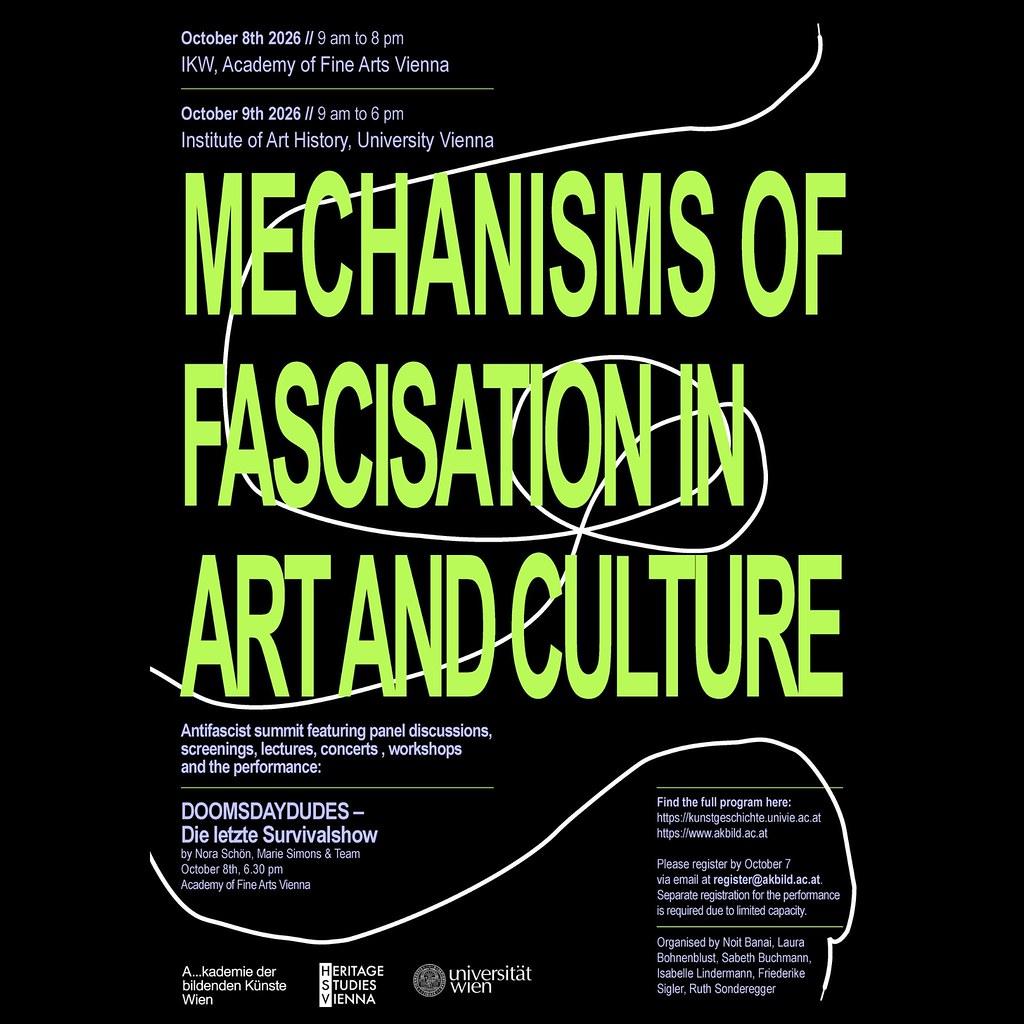
Mechanisms of Fascisation in Art and Culture
Verbindung zu esel.at
Organized from the Academy of Fine Arts Vienna and the Institute of Art History at the University of Vienna.
Noit Banai, Laura Bohnenblust, Sabeth Buchmann, Isabelle Lindermann, Ruth Sonderegger, Friederike Sigler
REGISTRATION
Please register by October 7 via email at register@akbild.ac.at.
Separate registration for the performance is required due to limited capacity.
Oktober 8 - Academy of Fine Arts Vienna, Schillerplatz 3, 1010 Wien, Mezzanine, Room M13a
Oktober 9 - Institute of Art History, University of Vienna, Garnisongasse 13, Campus Courtyard 9, Room 1 & 3
Fascist movements are exerting an ever-greater influence worldwide, whether through government agendas, direct political measures, or cultural hegemony. This also includes art and culture. The aim of our summit is to explore how art and culture are affected by processes of fascisation, how these processes manifest themselves, how they can be identified — and, in turn, what they reveal about the new fascisms of our time. Based on recent research into fascism, we assume that these dynamics are particularly significant in contexts where liberal-democratic institutions and assumptions have historically been regarded as safeguards against authoritarian encroachment, but they are also evident in societies undergoing processes of authoritarianisation and intensified state control. Many of these movements characteristically place art center stage in their political pursuits. By this, art’s validity as an unalloyed ‘good’ force, as espoused by the liberal hopes of modernity and 20th-century postwar democracies, is being called into question. Thus, one of the central theses of Critical Theory is up for discussion: Whether artistic and cultural practices must mobilize the power of self-negation against their instrumentalization as tools of identity formation and national self-affirmation—while also using this power to track down internalized micro-fascisms that are subsequently perverted by right-wing extremists and turned against minority-oriented struggles for inclusion and justice. Together with colleagues across the fields of art and culture who have encountered and been affected by these processes—including participants from Hungary, Italy, Serbia, Turkey, Hong Kong, and Austria—we consider how artistic practices and cultural institutions are shaped by fascisation and how, in turn, they may reproduce, negotiate, or contest them. To this end, we seek to extend the current research into fascism to encompass art and culture, whilst concurrently formulating anti-fascist practices. This focuses attention on replacements - already made or still possible - of authoritarian and exclusive notions of art and culture with non-hierarchical and pluralist aesthetics and concepts that can be linked to political solidarity beyond a divisive over-identification with particular interests —for instance, through common struggles for social rights and redistribution. The antifascist summit featuring panel discussions, screenings, lectures, concerts, workshops and performances is organized by the Academy of Fine Arts Vienna and the Institute of Art History at the University of Vienna.
Oktober 8 -
Martina Genetti, Alon Ishay, Elsa Logar, David Ressmann, Simon Nagy, József Mélyi, Kristóf Nagy, Miloš Janjić, Nenad Lajbenšperger, Tatjana Nikolić, Asena Günal, C&G, Ekaterina Shapiro-Obermair, Maurício Ianes, Nora Schön, Marie Simons & Team
Oktober 9 -
C&G, Asena Günal, Alessandra Ferrini, Anahita Neghabat, Maja Figge, Nikolaus Kockel, Jana Dolečki and other members of Hor 29. Novembar.