
Lukas Kaufmann: Garden in Hell
Zeitgenössische Kunst Ausstellung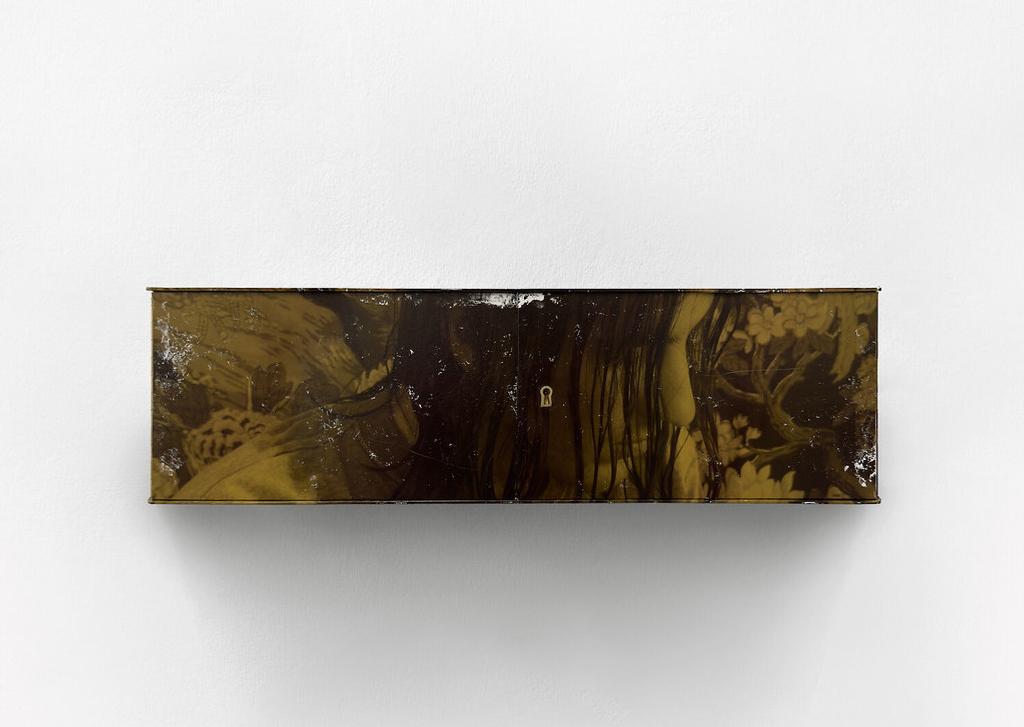
Verbindung zu esel.at
Opening
Thursday 5. 11. 2026, 6 – 8 pm
OC Bar hosted by Sophie Gogl
Joint opening with Charim Gallery
The German word während (“while”) dates back to the eighteenth century and evolved from the word währen (“to endure”), as a new way of expressing the state of something “continuing to be.” Während introduces relationality into währen, giving being a relationship, a point of reference between something that is here now and something else that continues to endure within the same space of existence. Thus, while one of Oliver Croy’s ancestors—Oliver being one of the owners of the gallery in which Lukas Kaufmann’s new exhibition Garden in Hell is on view—provides us, in his famous diaries, with a highly personal and detailed account of life at the court of the French queen Marie Antoinette, and above all of her as a person (a book that, strangely enough, happens to be lying on my desk as I write this text), Lukas Kaufmann snatches, in his exhibition at this gallery, a final loose thread from that period (also the eighteenth century). This loose thread, which we encounter in one of the works, is the textile wallpaper from Marie Antoinette’s bedroom, a small and extremely precious piece of fabric. Expensive because, originating in an idea of displayable excess, it could only have been produced through an equally excessive expenditure of resources—an abundance of time made available. “It’s the fabric with the flowers,” writes Lukas Kaufmann, but what we see above all are the ribbons: ribbons as strips of fabric and as patterns woven into the material, ribbons transformed into ornamental flourishes. A flourish, an embellishment formed from winding lines (the German word Schnörkel combining, here, Schnögel [snail], Zirkel [compass] and Schnirre [loop], and containing elements of all three), is like the trailing stroke of a signature, a line resembling a thought that does not yet wish to come to an end. These ribbons, which resemble probing tendrils, like the feelers of climbing plants turning in the sun’s orbit, are recurring elements in the different bodies of work that make up his sculptures. If you are familiar with Lukas Kaufmann’s work, you will recognize them. They have already been winding their way out of little boxes and jardinières—the name given to the tableware objects that the nineteenth century appropriated from aristocratic table centrepieces, transforming them into planters.
The French philosopher Gilles Deleuze (who, by the way, allowed his fingernails to grow out of his body like long loops, feelers extending between the world and his grasp of it) proposed the image of a body without organs—a body with no organs through which one might connect with it, grasp it or hold on to it—as a way of understanding the subject of capitalism. This is a subject that has withdrawn everything onto which anything might otherwise gain a foothold, in order to speed through time and space without being stopped or held back. Although this proposition from Anti-Oedipus is more than fifty years old, it finds a distinctly contemporary visual expression in the bodies of social media today (now also without nipples). The corporeality of Lukas Kaufmann’s work, by contrast, would represent its exact opposite: seeking points of connection, offering itself up, feeling its way towards relationships in its surroundings.In contrast to Deleuze’s self-contained schizo-bodies, Lukas Kaufmann’s objects evoke something like the self-centred assurance of the absolute body of the Ancien Régime, unfolding its secret outward as a gesture through endless loops. This was a dreamlike, reality-forgetting sense of security, nourished by ornamental flourishes, table centrepieces and dances. It was also a deceptive security, one that endured while, in a real world beyond it, with little time left for dreams, the world was in the process of rearranging itself. What followed were 150 years during which men no longer wore long hair—until approximately the time of Deleuze’s text. This long hair disappeared first at the nape of the neck, in a hairstyle known as à la victime. The style was borrowed by the Incroyables (and Merveilleuses), the young Parisians of the period, adopting it from the aristocrats on their way to the guillotine: the hair was cut short at the back, above the collar, while at the front it was left at its former length, falling across the face. In Lukas Kaufmann’s work, this hair reappears, tucked inside collars, as a final flourish in the persistence of a soft body—as though folded into the objects themselves, an internalized longing for connection, the trace of a probing attempt to find a point of attachment.
Lukas Kaufmann knows that all of this has also hardened into image, pose or style (just as RuPaul declares in Season 16 of RuPaul’s Drag Race: “No more Marie Antoinette!”). This, too, can be read in his exhibition, provided we recognize that the pages into which these gestures tentatively fold themselves belong to Interview, the magazine associated with the queen of style, Andy Warhol.
Garden in Hell is the title of the exhibition, as though the title were meant to undo itself: the garden—the hell. Kaufmann is referring, however, to the garden in the First Circle of Hell in Dante’s Inferno (The Divine Comedy), the circle inhabited by virtuous pagans, philosophers and great poets, where souls do not scream but merely sigh softly with longing. They dwell in a green meadow and, in any case—as one also knows of Hell—in endless duration.