
Fishy Business
Hydromorphologies and Wetware
Zeitgenössische Kunst
Ausstellung
Verbindung zu esel.at
Hydromorphologies and Wetware
Agnes Questionmark, Andreia Santana, Christina Gruber, Davide Bevilacqua, Elena Rocabert, Juan Pablo Pacheco and Nikolaus Eckhard
Curated By: Carmen Lael Hines and Lisa Jaeger
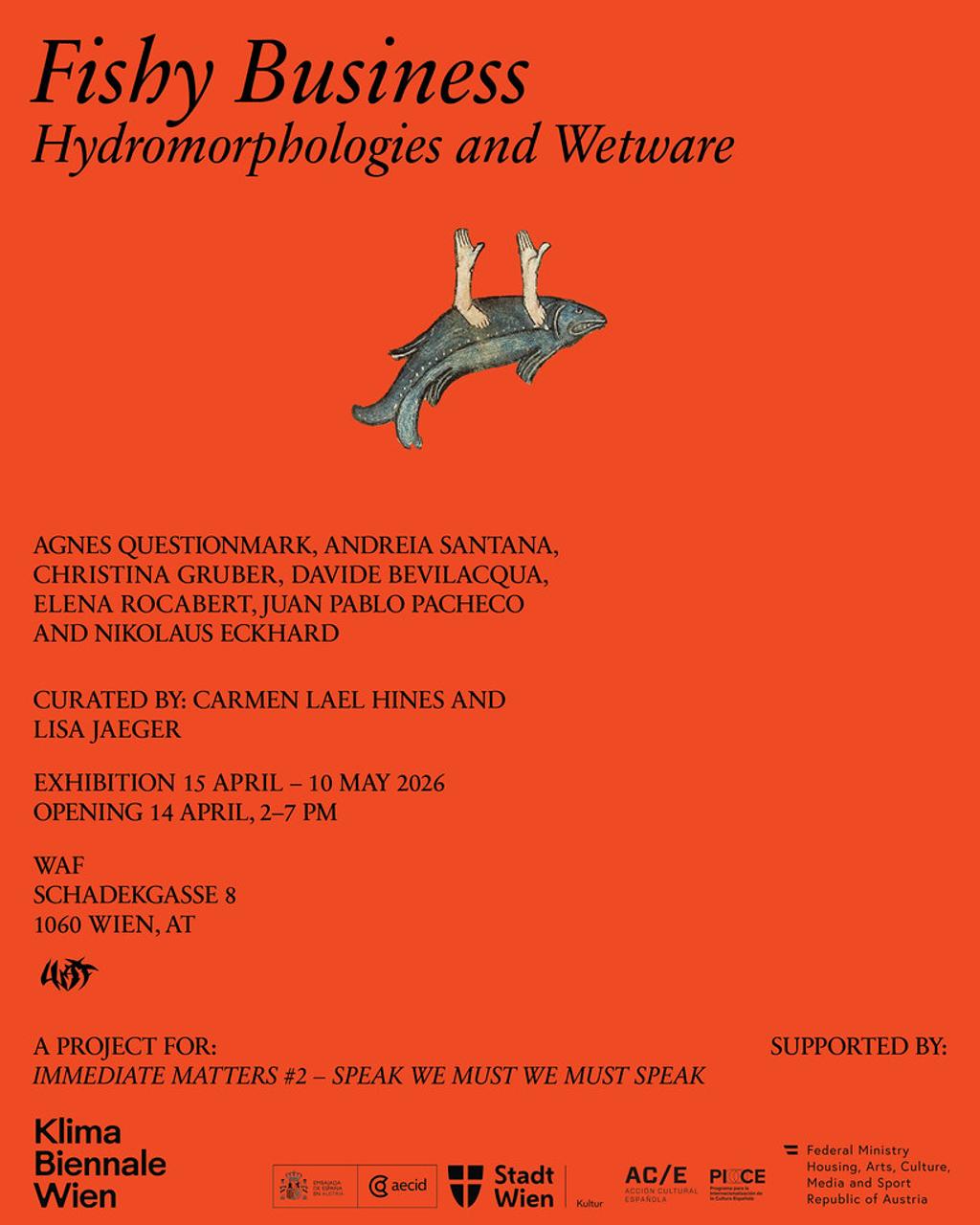
Fishy Business: Hydromorphologies and Wetware explores aquatic prostheses as epistemic and spatial tools. Bringing together art, architecture, biology, and myth, the exhibition asks how prosthetic interventions reshape interspecies care, ethics and cohabitation. Curated by Carmen Lael Hines and Lisa Jäger, it features works by Agnes Questionmark, Andreia Santana, Juan Pablo Pacheco, Elena Rocabert, Nikolaus Eckhard and Christina Gruber, using prosthesis to imagine alternative ontologies of care.
WAF’s contribution to the Klima Biennale, Fishy Business: Hydromorphologies and Wetware, invites artists, researchers, and spatial practitioners to reflect upon the Haus des Meeres through the conceptual lens of prosthesis. Prosthesis, with the etymology of “maintained against attack,” involves practices and mechanics of bodily extension, intrusion, and hybridity, along with etymological and significatory linkages to architecture and practices of knowledge production. As an epistemic lens, prosthesis is approached as a transdisciplinary strategy bringing together histories of medical sciences, architecture, computation, and troubling binaries separating animal, human, and technology.
Directly in front of the WAF gallery stands the Haus des Meeres Aqua Terra Zoo, an aquarium housed within a World War II flak tower and home to over 10,000 aquatic beings. Within 4,000 m² of concrete, layered infrastructures of logistics and care sustain the staged aesthetics of underwater ecologies. Conceived as a question, Fishy Business considers how aquatic prostheses – whether applied to human, fish, or hybrid bodies – might open new ways of thinking at the intersections of care, engineering, and marine species within the spatialities of hydrobiological life.
Curated by Carmen Lael Hines and Lisa Jäger, the exhibition will include artistic positions from Agnes Questionmark, Andreia Santana, Juan Pablo Pacheco, Elena Rocabert, Nikolaus Eckhard, and Christina Gruber. Works will take place both in and outside the exhibition space, including early morning canoeing on the Danube, LARPing, workshops, and open discussions. Questions surfacing across the projects relate to how humans attempt to interface with aquatic species—from the supportive technologies designed to aid marine animals to the mythological imagination of hybrid forms such as merpeople. By weaving together speculative design, biology, mythology, and architecture, the exhibition seeks to nurture a transdisciplinary platform for discussion, performance, and play. Realized with the support of Acción Cultural Española (AC/E ), La Embajada de España | Spanische Botschaft, Stadt Wien Kultur and BMWKMS.
A project as part of the Klima Biennale Wien 2026
and Immediate Matters #2 - Speak We Must We Must Speak.
