
Dirty Pink Waters of Collectivity: Book Launch
Theorie Literatur Präsentation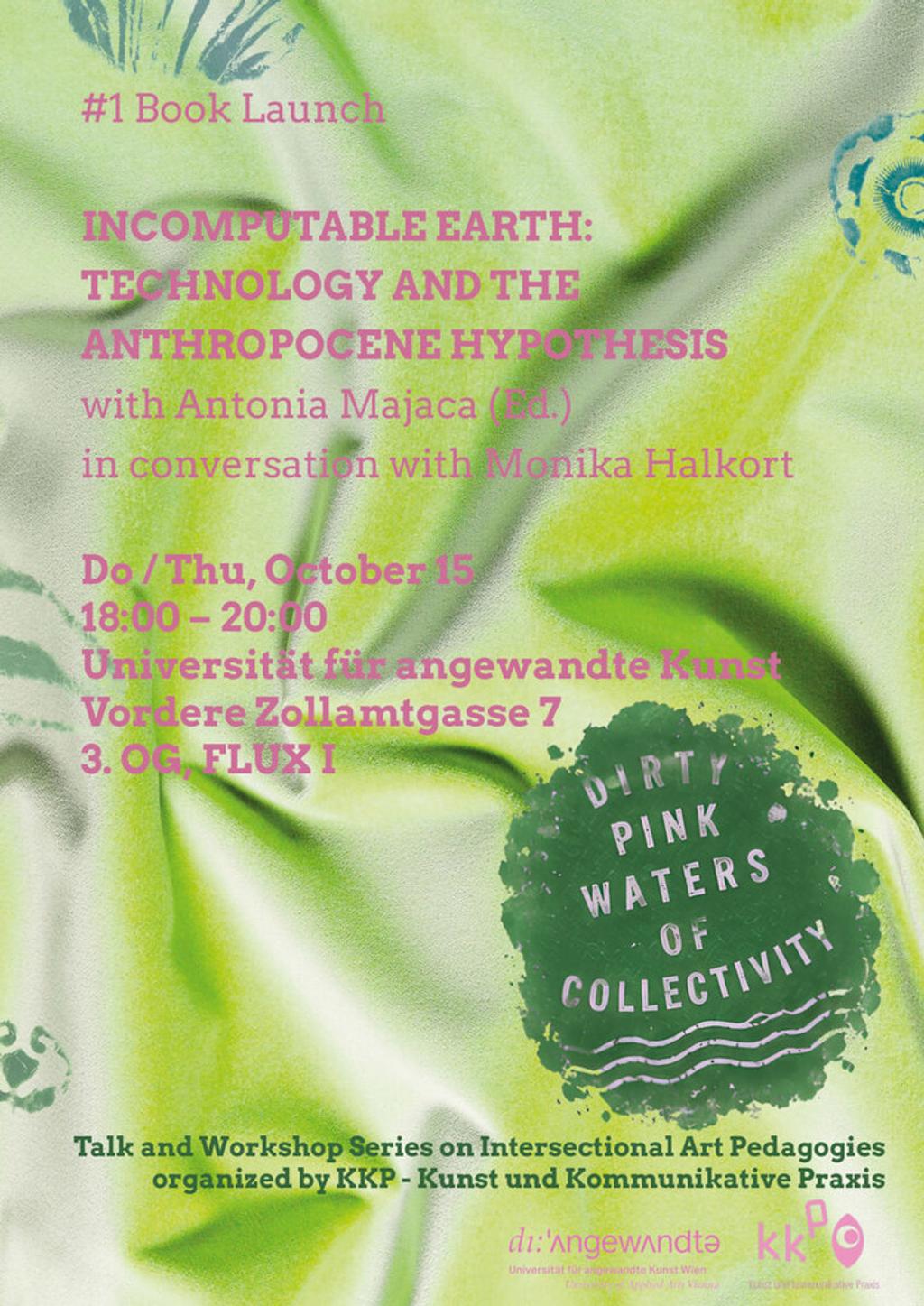
Verbindung zu esel.at
Talks and workshops Series on Intersectional Art Pedagogies
Organisiert von der Abteilung Kunst und Kommunikative Praxis (KKP)
Dirty Pink Waters of Collectivity (DPW) ist eine interdisziplinäre Veranstaltungsreihe, die sich mit intersektionaler Kunstpädagogik befasst, sie inkludiert verschiedene Formate wie Vorträge, Filmvorstellungen, Aktzeichnen und Workshops.
Die Reihe adressiert kollektive Praktiken in Kunst und Bildung, die intersektionale und post-migrantische Positionen verstärken. Kunstpädagogik wird weltbildend, wenn sie ihre Beziehungsfähigkeit (Relationalität), das Ent-üben und das Nicht-Wissen in die Praxis umsetzt. Sie schafft Raum für widersprüchliche, ineinandergreifende und fließende Identitäten und lässt Raum für die Verschmutzung der dominanten Sprache(n) zu.
DPW wird kuratiert und organisiert von Sofia Bempeza, Annette Krauss und Verena Melgarejo Weinandt, Abteilung Kunst und Kommunikative Praxis (KKP) der Universität für Angewandte Kunst Wien.
#1 Book Launch
Incomputable Earth, Technology and the Anthropocene Hypothesis
with Antonia Majaca (Ed.) in conversation with Monika Halkort
The event will be held in English
Incomputable Earth: Technology and the Anthropocene Hypothesis (Bloomsbury, 2026), edited by Antonia Majaca, challenges the dominant narrative that positions technological solutions as the primary response to ecological crisis. This open access collection argues that climate breakdown represents an irreducibly incomputable problem that cannot be resolved through algorithmic optimization or cybernetic planetary management. Radically interrogating the political epistemology underlying the Anthropocene hypothesis against the backdrop of new regimes of algorithmic classification and prediction, this volume addresses the crucial need to rethink the meaning and inter-relationality of “human,” “nature,” and “technology.” Drawing on feminist science studies, decolonial epistemologies, and historical materialist analysis, the contributors examine how computational frameworks transform Earth’s complex relationships into extractable data, perpetuating the very logics that created planetary crisis.
Examining new forms of subjectivity and resistance, this timely volume provides both rigorous critique of technoscientific planetary governance and speculative horizons for collective response to climate breakdown-offering a blueprint for reclaiming abstraction from computational capture while centering radically transformed ways of knowing and being human.
Antonia Majaca is a Research Fellow in the Department of Philosophy and Cultural Heritage at Ca‘ Foscari University of Venice, Italy, where her research within the ERC-funded HealthXCross project examines microbiome technoscience through decolonial feminist and historical materialist analysis. She founded and coordinates the research cluster „Radical Epistemologies: Political Ecology and Transversal Praxis“ at the NICHE Institute for Environmental Humanities, Ca‘ Foscari. She was Principal Investigator of the Austrian Science Fund (FWF) artistic research project „The Incomputable,“ from which this volume emerged. She has directed research, curatorial, discursive, and publishing projects for Documenta 14, the Venice Biennale, Berlin Biennale, and HKW Berlin.
Monika Halkort is an assistant professor and head of the School for Transformation at Angewandte in Vienna. The School is an inter-university initiative for transdisciplinary research, education, and critical practice, launched in 2023. Her current research focuses on political ecologies of transformation, emphasizing the material entanglements of extractivism, circularity and just transition discourses in post-mining societies.